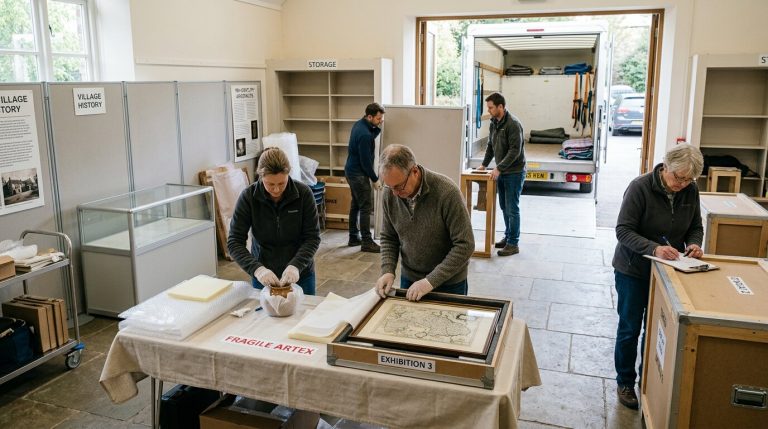

Most small exhibitions are moved by volunteers, in borrowed cars or a hired van, on a single Saturday. That works well for display boards, banners and empty cases. It’s the wrong approach for anything old, rare or borrowed.
So the first job isn’t booking a van. It’s sorting everything you plan to move into two groups: equipment, which you can load yourselves, and objects, which may need packing advice, insurance and possibly a specialist. Get that split right and the rest of the move is ordinary logistics.
Step one: make an inventory before anything is packed
Walk round the current display, or the store, with a clipboard or a phone. Give every item a line, even the boring ones. The extension lead and the box of Blu Tack go missing just as often as the panels.
For each line, note what it is, its rough size and weight, how many people it takes to lift, and who owns it. That last column matters. Items lent by a family, a parish or another museum belong to someone else, and the Collections Trust’s suggested procedure for moving objects advises getting the owner’s agreement before anything you don’t own is moved, and arranging insurance or indemnity in line with your own policy.
Step two: separate display furniture from artefacts
Here’s a simple way to sort the list.
- Display furniture and equipment: free-standing panels, pop-up banners, plinths, empty cases, lighting, tablecloths, leaflet stands. Volunteers and a hired van can usually handle these.
- Robust, low-value objects: reproduction items, handling collections, modern replicas. Pack them well and they can often travel with the equipment.
- Fragile, valuable or borrowed objects: original documents, photographs, ceramics, textiles, anything with a story attached and no replacement. Stop and take advice before these go anywhere near a van.
The Collections Trust notes that objects in transit need protection from environmental change and vibration, that a conservator’s advice is worth getting if you’re unsure, and that higher-value objects may need specialist museum shipping agents. A hired van with a volunteer driver gives you none of that by default. If the third group is large, consider moving it separately, or not at all, and showing good photographs or facsimiles instead.
Step three: check access at both ends
The procedure above also stresses checking access at the collection point and the destination. For a village hall or library, that means a few specific questions:
- Where can a van park to load, and for how long?
- Are there steps, narrow doors or a lift with a weight limit between the van and the room?
- Who holds the keys, and what time can you get in on the day?
- Is there anywhere to store empty crates and packing during the show?
Measure the tallest panel and the widest case against the narrowest doorway. A Luton box van with a tail lift helps with heavy cases, but it won’t get a case through a door it doesn’t fit.
Step four: choose the van and the driver
Size the van to the furniture list, not to the whole inventory, because the fragile objects should be travelling another way. Two practical points:
- Licence. A standard category B car licence covers vehicles up to 3,500kg maximum authorised mass for petrol and diesel, according to GOV.UK. Most panel vans and many Luton vans sit at or below that, but check the plated weight of the van you’re offered.
- Driver paperwork. Hire firms often ask for a DVLA check code, which the driver can generate online and which lasts 21 days (GOV.UK). Sort it out the week before, not on the morning.
Volunteers who aren’t driving travel in a car or the van’s cab seats. Nobody rides in the back with the panels.
Enquiry options near the Staffordshire border
For a group based in east Staffordshire, two enquiry options lie a short way east, in north-west Leicestershire and south Derbyshire. The table below describes what each page lists. It isn’t a ranking.
| Enquiry option | Area served (as stated on the page) | What the page lists | Ask before booking |
|---|---|---|---|
| Coalville van hire options | Coalville and nearby places such as Whitwick, Ibstock and Measham | Small vans through to Luton box vans with tail lift, dropsides and tippers; says delivery and collection can be arranged | Internal height and length of the exact van; whether a tail lift is included; delivery to your store |
| vanhireswadlincote.co.uk | Swadlincote, south Derbyshire | A similar range, from a VW Caddy to a Luton box van with tail lift | Insurance excess; whether the hirer’s cover extends to contents at all; return time |
The two websites use the same design, the same fleet list and the same phone number, so they may well be one network rather than two independent firms. Treat them as two routes to an enquiry, and confirm every detail directly.
Exhibition inventory and packing checklist
Copy this into a spreadsheet, one row per item.
| Column | What to record |
|---|---|
| Item no. | A number that also goes on the item’s box or label |
| Description | “Panel 4: mining heritage”, “Glass case, small”, “Loan: 1920s photograph” |
| Group | Furniture / robust object / fragile, valuable or borrowed |
| Owner | Society, named lender or other museum |
| Size and weight | Rough dimensions; one-person or two-person lift |
| Condition out | Short note plus a photo before packing |
| Packing | Blanket, bubble wrap, archive box, crate, or “specialist” |
| Travels by | Hired van / volunteer car / specialist / not moving |
| Condition in | Checked and photographed on arrival, initialled |
| Returned | Date back in store or with the lender, initialled |
Flag for professional advice if any of these apply
- The item is original, old or irreplaceable.
- It’s on loan, or the owner has asked for special care.
- It’s sensitive to light, damp, heat or vibration (paper, photographs, textiles, some metals).
- You can’t say what it’s worth or how it’s insured.
The return is part of the move
Exhibitions are packed carefully on the way out and in a hurry on the way back, usually at the end of a long final day. Book the van for the take-down with as much slack as the set-up, keep the same inventory, and tick every item back in, especially the ones that belong to somebody else.
